

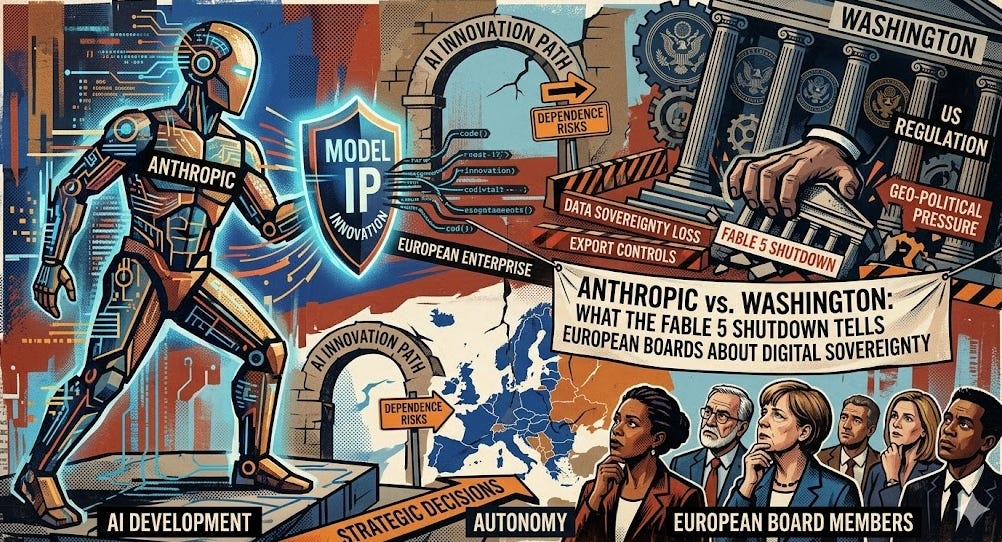
On the evening of Friday 12 June 2026, Anthropic disabled its two most capable models — Fable 5 and Mythos 5 — for every customer, everywhere. Not just users in Tehran or Shenzhen. Everyone. The trigger was a directive from the US government, citing national-security authorities, ordering the company to suspend all access to those models by any foreign national, whether inside or outside the United States — including Anthropic’s own foreign-national employees. Because the company had no clean way to fence off only foreign users at short notice, the only way to comply was to pull the plug for the entire customer base. Its other models were left untouched.
That single operational fact — a commercially deployed system reaching a global audience, dark within hours of a government letter — is what should hold a CXO’s attention, regardless of where one sits on the underlying dispute. So let me try to separate the signal from the noise, and then offer some practical counsel for European and UK organisations.
What actually happened
The order arrived as an export-control directive from the US Commerce Department. Commerce Secretary Howard Lutnick wrote to Anthropic CEO Dario Amodei stating that Mythos 5 and Fable 5 would be subject to export controls covering any location outside the US and all foreign persons within it, and that licences would now be required for their export, re-export or even domestic transfer.
The stated rationale was national security. Reporting indicates the administration became alarmed after a third party claimed it could “jailbreak” Mythos — bypass its safeguards — in a way that might unlock advanced cyber-offensive capability. Anthropic’s public response was notably unhappy: it said the demonstrated technique surfaced only a small number of previously known, minor vulnerabilities; that the evidence provided was verbal rather than documented; and that other publicly available models — it named a competitor’s flagship — could likely do the same and were not subject to equivalent controls. The company called the position a misunderstanding and said it is working to restore access.
Two points matter for the analysis. First, this was an availability event, not a data breach — the risk that materialised was loss of access, imposed by a third party with legal authority over the vendor. Second, the collateral radius was total: a compliance obligation aimed at foreign nationals took the service away from all customers because of how the controls were drawn. For anyone thinking in terms of operational resilience, both characteristics are the interesting part.
The context: a vendor at war with its own government
It would be a mistake to read the Fable 5 order in isolation, because Anthropic and Washington have been locked in an escalating standoff for months. In March 2026 the Pentagon designated the company a “supply chain risk” — effectively a blacklist requiring defence contractors to certify they do not use its models — after Anthropic refused to drop its guardrails against autonomous-weapons use and mass domestic surveillance. The company sued, arguing the move was unlawful retaliation; an appeals court declined to pause the designation in April, and oral arguments ran through May. Senior officials have publicly derided the firm’s safety posture as “woke AI,” and the President himself has called it, in characteristically blunt terms, a “radical left” company.
The result is a striking paradox, and an important one for our purposes: Anthropic is simultaneously deemed too dangerous for the US government to rely on and too dangerous to let foreigners use. That tension tells us the Fable 5 order is, at least in part, the latest move in a company-specific feud — not solely a clean statement of policy toward allied nations. Holding that nuance is essential if we want an honest read rather than a satisfying one.
An objective read: three interpretations, not one
The temptation is to treat this as proof of a single thesis. The more defensible approach is to hold the competing explanations side by side and ask which one our planning should respond to.
Interpretation one — a narrow, one-off security action. On this reading, the order is exactly what it says: a specific, possibly transient response to a specific frontier-AI vulnerability with potential cyber implications. If so, it says little about how Washington views Berlin or London, and access may well be restored within weeks.
Interpretation two — collateral damage from a domestic fight. Here, foreign users are simply caught in the crossfire of the Anthropic–Pentagon dispute. The “foreign access” framing is the lever that happened to be available, not evidence of a coordinated posture toward allies.
Interpretation three — a structural signal. On this view, motive is almost beside the point. What has now been demonstrated is the combination that matters to any risk manager: the United States possesses the legal machinery to switch off critical, commercially deployed digital infrastructure on national-security grounds, and it is willing to use it — even where the collateral effect falls on allied businesses and on the vendor’s own staff.
These are not mutually exclusive, and the mature conclusion is uncomfortable for the reflexive optimist and the reflexive hawk alike. Even if interpretation one is the literal truth this week, interpretation three is the one a competent board must plan against — because in resilience work you plan against demonstrated capability and willingness, not against stated intent. Intent is revisable on a Friday afternoon. Dependency is not.
The question for a board is not whether Washington meant this as a message to Europe. It is whether your organisation could absorb the same action if it were ever pointed your way.
Why this lands so hard in Europe right now
The episode arrives on top of a sovereignty conversation that has already moved from think-tank seminar to government policy. Just nine days earlier, on 3 June 2026, the European Commission published its EU Tech Sovereignty Package, bundling a Chips Act 2.0, a Cloud and AI Development Act (CADA), and an EU Open Source Strategy — explicitly intended to reduce reliance on US and other non-EU technology.
The Commission has separately been weighing limits on the use of US cloud platforms for sensitive public-sector data, and has funded work on a Cloud Sovereignty Framework. Member states are acting unilaterally too: France ordered some 2.5 million civil servants off Microsoft Teams and Zoom and onto a domestically hosted platform by 2027, while Germany’s armed forces stood up an air-gapped sovereign cloud in domestic data centres. Analysts at Gartner expect worldwide sovereign-cloud spending to approach $80 billion this year, with European spending growing more than 80% year on year. The “Eurostack” vision — a full European stack from chips to cloud to AI — has graduated from manifesto to coordinated industrial policy.
The animating fear behind all of this was, until last week, largely hypothetical: that Washington might one day weaponise everyday digital dependence to extract concessions. The Fable 5 order does not prove that fear in full — but it moves it measurably from theory toward precedent, and European policymakers will read it that way.
And yet — the objective case requires the other half of the ledger. Decoupling is far easier to declare than to execute. EU officials themselves are careful to call the goal “strategic autonomy,” not separation.
Forrester forecasts that no European enterprise will move entirely off US hyperscalers in 2026. The scale gap is brutal: US providers are deploying on the order of $600 billion in cloud and AI capacity this year, against a European base a fraction of that size. Most damningly, European militaries remain dependent on US software and networks for communications and intelligence, and defence officials have warned that abrupt restrictions could degrade operational capability.
Sovereignty, in other words, is a multi-year programme with real costs and real trade-offs — not a switch of its own that Europe can simply flip in retaliation.
“But what if it were Microsoft?”
This is the question I am asked most often, and it deserves a straight answer rather than a comforting one. There is a genuine distinction between a frontier AI model placed under national-security export controls and a mass-market productivity suite that hundreds of millions of businesses depend on daily. The former is a far more plausible target for this kind of action than the latter; a Fable 5 shutdown is not the same risk profile as Microsoft 365 going dark.
But the distinction is one of degree and likelihood, not of mechanism. The same extraterritorial legal architecture — export controls, the CLOUD Act, surveillance statutes — already reaches US-headquartered providers regardless of where their data centres sit, which is precisely why the Commission is examining cloud exposure for sensitive government data.
The honest position is therefore neither “this could never happen to core enterprise tooling” nor “your tenant will be switched off next week.” It is: the lever exists, it has now been pulled once in public, and a serious risk function should treat the probability as non-zero and size its mitigations accordingly.
What European and UK boards should actually do
The right response is not ideological decoupling, and it is certainly not panic. It is disciplined resilience engineering — the same craft we apply to any concentration risk. Concretely:
Map your concentration and jurisdictional exposure. For each critical capability, document where it sits, who controls it, where the data resides, and — crucially — which jurisdiction’s law governs it. You cannot manage a dependency you have never named. Single US-controlled providers underpinning a critical process are the items to flag first.
Add “third-party switch-off” to the risk register, then test it. Run a tabletop exercise on the sudden loss of a key US AI or cloud service with little notice. The Fable 5 timeline — letter at 5:21pm, service dark the same night — is your scenario parameter. Measure how long your operations survive and what breaks first.
Engineer portfolio diversity, not a single bet. Pursue multi-model and multi-cloud designs for critical workloads, and keep at least one credible non-US or open-weight fallback. Open-weight models you can self-host are the one option that removes the external kill-switch entirely — that property, not benchmark scores, is the point in a resilience context.
Use contracts and architecture as controls. Insist on exit clauses, data-residency guarantees, EU-region and sovereign-cloud options, and customer-held encryption keys. Build portability and abstraction layers so a provider swap is an engineering task, not an existential one. Architectural lock-in is a choice; make it deliberately, not by default.
Match the level of sovereignty to the sensitivity of the workload. Sovereignty is a spectrum — data residency, then operational sovereignty, then full-stack independence — each with rising cost. Your classified or regulated workloads may warrant the top of that ladder; your marketing analytics almost certainly do not. Resilience, proportionate to risk, beats autarky every time.
Take it to the board as enterprise risk, and align it to the rules you already answer to. Frame the exposure in the language of NIS2, DORA and the EU AI Act, and document your critical dependencies for regulators who are increasingly asking the same questions. This is governance, not geopolitics.
Watch the policy space. CADA, the Cloud Sovereignty Framework and public-sector procurement signals will shape both the available alternatives and your future compliance obligations. The organisations that read the regulatory weather early will have the cheapest, calmest migrations.
The bottom line
The Fable 5 episode is less a verdict on American intentions than a stress test that exposed a structural dependency many boards had quietly accepted. Read soberly, it does not vindicate either the maximalists who want to rip out every US asset tomorrow or the complacent who insist nothing has changed. It vindicates the engineers and risk officers who have been arguing, unglamorously, for diversification, portability and sovereignty-by-design proportionate to the sensitivity of the work.
Decoupling, as a slogan, is the wrong frame — it is slow, costly and, for now, partly impractical. Resilience is the right one. The leaders who treat last Friday as a prompt to map their single points of failure and methodically reduce them — rather than as either a non-event or a casus belli — will be the ones still standing whichever way the geopolitics ultimately breaks.
References
Anthropic — Statement on the US government directive to suspend access to Fable 5 and Mythos 5 (12 June 2026). https://www.anthropic.com/news/fable-mythos-access
Bloomberg — Anthropic Says US Orders Halt to Foreign Access for Fable 5, Mythos 5 AI Models (13 June 2026). https://www.bloomberg.com/news/articles/2026-06-13/anthropic-says-us-limits-foreign-access-to-fable-5-mythos-5
CNBC — Anthropic disables access to Fable 5 and Mythos 5 to comply with government directive (12 June 2026). https://www.cnbc.com/2026/06/12/anthropic-disables-access-to-fable-5-and-mythos-5-to-comply-with-government-directive.html
Axios — Scoop: Trump admin blocks foreign access to Anthropic’s most powerful AI (12 June 2026). https://www.axios.com/2026/06/12/anthropic-trump-mythos-fable-national-security
NBC News — Anthropic suspends new AI models after government directive (12–13 June 2026). https://www.nbcnews.com/tech/tech-news/anthropic-suspends-new-ai-models-fable-mythos-government-directive-rcna349901
Fortune — Anthropic disables Fable and Mythos AI models after U.S. government bars it from giving foreigners access (13 June 2026). https://fortune.com/2026/06/13/anthropic-disables-fable-mythos-export-controls-national-security-threat/
CNBC — Anthropic sues Trump administration over Pentagon blacklist (9 March 2026). https://www.cnbc.com/2026/03/09/anthropic-trump-claude-ai-supply-chain-risk.html
NPR — Hegseth threatens to blacklist Anthropic over ‘woke AI’ concerns (24 February 2026). https://www.npr.org/2026/02/24/nx-s1-5725327/pentagon-anthropic-hegseth-safety
Axios — Trump administration doubles down on Anthropic blacklisting in court arguments (19 May 2026). https://www.axios.com/2026/05/19/anthropic-trump-administration-court-arguments
Akin Gump — EU Tech Package Unveiled: How the EU Plans to Shift to Digital Sovereignty (June 2026). https://www.akingump.com/en/insights/alerts/eu-tech-package-unveiled-how-the-eu-plans-to-shift-to-digital-sovereignty
CNBC — EU weighs restricting use of U.S. cloud platforms to process sensitive government data (7 May 2026). https://www.cnbc.com/2026/05/07/eu-commission-cloud-sensitive-data.html
Bloomsbury Intelligence and Security Institute — European Tech Sovereignty and the Security Risks of Decoupling (March 2026). https://bisi.org.uk/reports/european-tech-sovereignty-and-the-security-risks-of-decoupling
Foreign Policy — Europe’s Digital Sovereignty Means Decoupling From U.S. Technology (27 February 2026). https://foreignpolicy.com/2026/02/27/europe-technology-digital-sovereignty-eu-decoupling-us/
Atlantic Council — Digital sovereignty: Europe’s declaration of independence? (February 2026). https://www.atlanticcouncil.org/in-depth-research-reports/report/digital-sovereignty-europes-declaration-of-independence/
Forrester — 2026 European Predictions (Technology & Innovation Summit EMEA, London). https://www.forrester.com/press-newsroom/forrester-european-2026-predictions
This article reflects the author’s analysis of publicly reported events as at 13 June 2026 and is offered as commentary, not legal or investment advice.